

Whether you enjoy the occasional kickabout or play for your Sunday league team, football is a great way to exercise your muscles and cardiovascular system. But as a high-intensity sport, it also puts you at risk of injuries.
Here, we will explore the most common football injuries, how they are treated and how you can reduce your risk of injury. It’s important to note that certain injuries are more common depending on your age.
Children and adolescents are more likely to sustain overuse injuries and injuries to the growth plates of their bones because they are still growing. Adults are more likely to sustain strains and sprains.
At any age, it’s your lower body that is most likely to be injured while playing football.
6 common football injuries
While playing football, you can sustain both contact injuries, such as when tackling or due to an unexpected collision, and non-contact injuries, such as during explosive movements eg pivoting or jumping. You can also develop overuse injuries when, over time, repeated movements cause wear and tear of soft tissues.
The 6 most common football injuries all affect the lower limbs:
1. Ankle sprain
A sprained ankle occurs when a ligament (fibrous tissue that connects one bone to another) in the ankle joint is overstretched. Most ankle sprains occur when the foot rolls inward, overstretching the outer (lateral) ligament.
The severity of an ankle sprain depends on whether the ligament tears or not. A mild sprain involves no tearing, while moderate and severe sprains involve partial and complete tears, respectively.
Immediately following an ankle sprain, you should follow the RICE principle:
- Rest — to prevent further damage, avoid bearing weight on your ankle whenever possible; for severe sprains, you may need to use crutches
- Ice — apply an ice pack or bag of frozen vegetables wrapped in a tea towel on your ankle for up to 20 minutes every 2–3 hours to reduce swelling
- Compression — support your ankle as it heals by wrapping a bandage around it; avoid wrapping it too tightly as this can reduce blood supply to your ankle and hamper healing
- Elevate — whenever possible, raise your ankle above the level of your heart to reduce swelling
You should also protect your ankle by wearing supportive footwear with good cushioning. For severe sprains, you may need to wear an ankle boot.
As your ankle sprain heals, you can gradually bear weight on it. Physiotherapy exercises can also help strengthen your ankle joint so you can return to playing football sooner.
A mild ankle sprain may only take a week to recover from, while a severe ankle sprain can take as long as 6 months.
2. Anterior cruciate ligament (ACL) injury
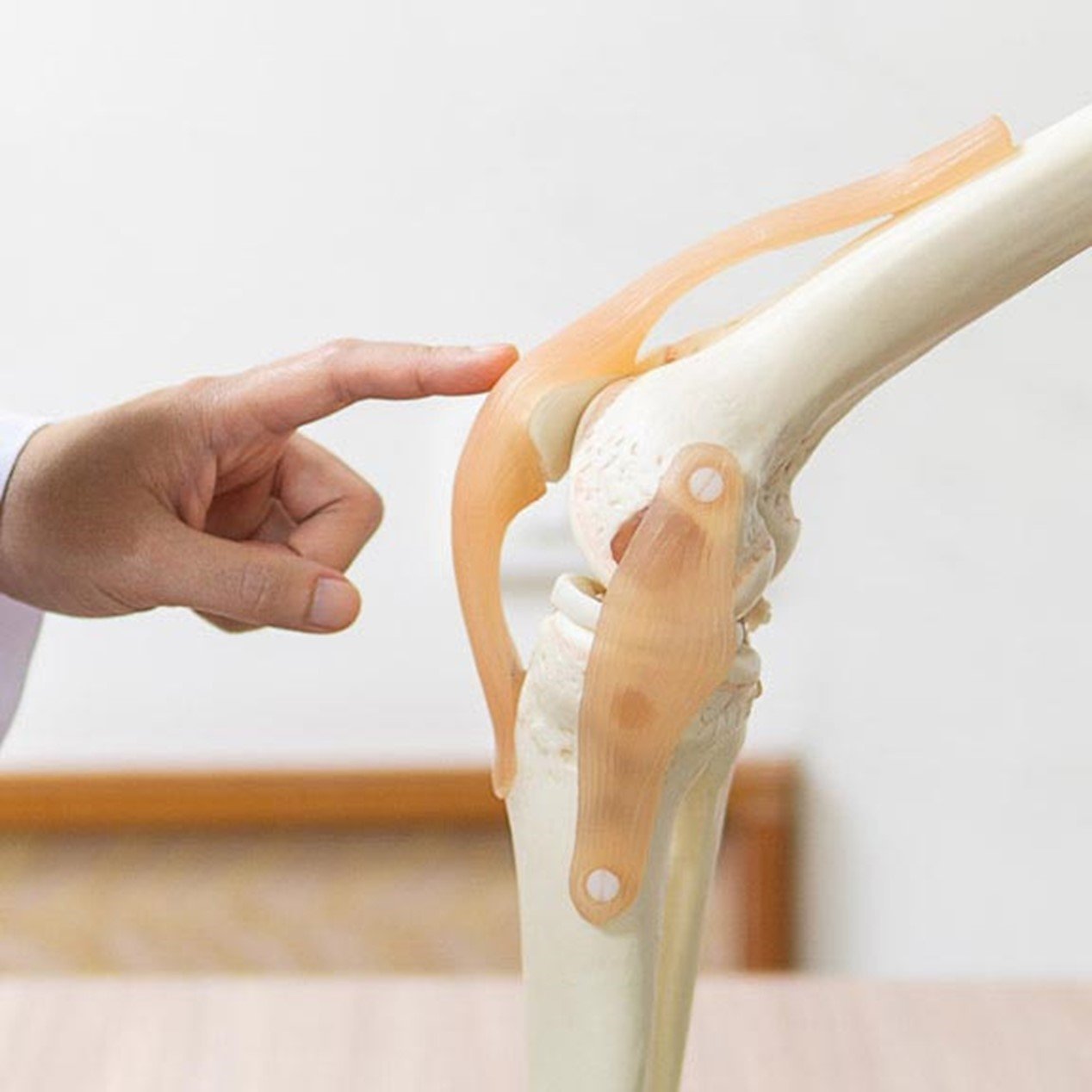
Your ACL is one of 4 major ligaments in your knee. It’s the most commonly injured knee ligament in football. Your ACL connects your thigh bone (femur) to your shin bone (tibia) and can be torn when your knee is twisted or overextended. It can also tear if you suddenly change direction or stop, or if you land awkwardly after a jump.
As with ankle sprains, ACL tears can be graded depending on whether the ligament is overstretched but intact, partially torn or completely torn (ruptured). Initial treatment involves following the RICE principle described above but for your knee joint.
For mild ACL injuries, regular physiotherapy to strengthen the joint can be enough for a complete recovery. However, for a torn ACL, you will likely also need surgery to repair the tear, followed by physiotherapy. It takes up to 9 months to fully recover from a torn ACL.
3. Quadriceps strain
Your quadriceps refer to 4 large muscles at the front of your thigh. Any one of these muscles can be torn due to overstretching during a side tackle or if you fall backwards, or due to a forceful contraction when you suddenly change direction, jump, kick or sprint.
The severity of the tear determines how long it takes to recover from this injury, ranging from a week to up to 6 months.
Less commonly, the quadriceps can be injured due to overuse, which causes micro-tears to form in the muscles.
Quadriceps strains are treated by following the RICE principle of rest, ice, compression and elevation, as well as physiotherapy to rebuild strength in the muscles.
It is, however, common for quadriceps injuries to recur due to ongoing weakness in the muscles. This is why rehabilitation of the muscles, by gradually increasing the range of motion and load placed on them, is so important.
4. Hamstring injury
Your hamstrings refer to 3 muscles that run from the back of your knee to your hip and are used to bend your knee, extend your hip and turn your lower leg. Consequently, they can be injured while playing football when you suddenly change direction, jump, kick or sprint.
Hamstring strains occur when the muscles are overstretched or develop tears, and are treated in the same way as quadriceps strains. This involves following the RICE principle and gradually rehabilitating the muscles through physiotherapy exercises and, eventually, strength-training exercises.
While mild injuries can heal in a week, recovery from the most severe hamstring strains can take up to 6 months.
5. Meniscus tear
A meniscus is a C-shaped piece of cartilage in your knee that acts as a cushion between the top of your tibia in your lower leg and the bottom of your femur in your upper leg. There are 2 menisci per knee, 1 on the outer side of the knee (lateral meniscus) and 1 on the inner side of the knee (medial meniscus). It’s more common to develop a tear of the medial meniscus.
While playing football, a meniscus tear is most likely to occur when you suddenly change direction or pivot, or during a tackle.
It’s important to follow the RICE principle (rest, apply an ice pack, compression with a bandage and elevation above your heart) as you recover from a meniscus tear. Physiotherapy can also help by strengthening your knee joint and restoring its range of motion. You can expect to recover from a mild to moderate meniscus tear in 1–2 months.
In severe cases, where the cartilage has completely split, surgery called a knee arthroscopy may be needed to repair the meniscus or remove the torn piece. If a repair is needed, it can take up to 9 months for a complete recovery.
Bones and joints
If joint pain, stiffness or injury is affecting your daily life, we’re here to help.
At Spire Healthcare, our experienced orthopaedic consultants and specialists offer fast access to diagnosis, physiotherapy and surgery.
6. Achilles tendonitis
Your Achilles tendon connects the calf muscles of your lower leg to the back of your heel bone. When playing football, this tendon is strained when changing direction, jumping and sprinting.
The most common Achilles tendon injury is Achilles tendonitis (inflammation of the tendon). This is caused by overuse, that is, repetitive movements that cause wear and tear over time.
Achilles tendonitis is treated by following the RICE principle and then performing regular physiotherapy exercises. It usually takes 3–6 months for a complete recovery.
However, if after several months, there is little or no recovery, your physiotherapist or doctor may recommend shockwave therapy or injections of platelet-rich plasma (PRP).
Preparing for football season: injury prevention
You can reduce your risk of sustaining an injury while playing football by making sure your body is ready with pre-season strength-training exercises focused on your lower limbs. This may include squats, lunges, sitting knee extensions and glute bridges.
Whether you’re getting your body in shape before football season starts or about to run onto the pitch, you should always warm up properly first. Without a warm-up, your muscles, ligaments and tendons are all stiffer and more likely to be injured. Jogging on the spot and dynamic stretches of your limbs and back all help warm up your body.
Cooling down after a match is equally as important as warming up to gradually restore your heart rate and help prevent muscle stiffness. Static stretches are particularly helpful during a cool down as your muscles are already warm and, therefore, more flexible, which makes deep stretches easier.
While you are on the pitch, wearing proper football shoes (ie supportive shoes with studs) as well as shin guards will also reduce your risk of injury.
Finally, make sure that you get enough rest between matches and training. This will help prevent overuse injuries but also reduce your risk of acute injuries by giving your muscles, ligaments and tendons the chance to properly recover from previous activity.
If you do sustain an injury, make sure you give yourself enough time to fully heal before you return to playing football or any other sports. Returning too soon not only risks worsening your existing injury but also makes it more likely you will sustain another injury.
